

This literature review and market research whitepaper synthesizes technical research, supply chain dynamics, and regulatory shifts surrounding Poly(methyl vinyl ether-alt-maleic anhydride) (PVM/MA Copolymer) and its derivative ester/salt architectures. Grounded in peer-reviewed findings from Nature Communications, Journal of the American Chemical Society (JACS), and market analytics from ICIS and S&P Global, this report evaluates the transition of PVM/MA copolymers from traditional oral bioadhesives to next-generation energy storage binders, microencapsulation vectors, and green cosmetic film-formers. The global market is projected to expand at a CAGR of 5.8% from 2026 to 2030, driven by surge demand in bio-compatible oral hygiene, clean-label hair styling, and lithium-ion battery electrode formulation.
Recent scholarly literature (2025–2026) highlights three major technological inflection points for PVM/MA functional derivatives:
Rather than relying on generic encyclopedic definitions, procurement managers and R&D chemists require a direct Buyer's Guide mapping commercial grade architectures to functional applications. PVM/MA copolymer technology spans six core product categories, detailed below:
| Product Commercial Name | Chemical Structure / Form | Key Physical Properties | Primary Technical Applications |
|---|---|---|---|
| PVM/MA Copolymer Powder | Alternating Anhydride Polymer (Powder) | Solvent-soluble, hydrolyzes in water to free acid; Mw: 200k–2.0M Da | Industrial coatings, microencapsulation, membrane modification, battery binders. |
| PVM/MA Acid (Free Acid Form) | Poly(methyl vinyl ether/maleic acid) Aqueous Solution | Clear viscous liquid, pH 2.0–3.0, high carboxyl density | Oral care tartar control, toothpaste bioadhesion, aqueous cleaning thickener. |
| PVM/MA Mixed Salts (Ca/Na) | Mixed Calcium/Sodium Salt Copolymer Powder | Off-white powder, extreme bioadhesive strength upon hydration | Denture fixative creams, mucosal drug delivery patches, medical adhesives. |
| PVM/MA Ethyl Ester | Ethyl Half-Ester in Ethanol Solution | Ethanol solution, flexible film-former, hydrophobic upon drying | Aerosol hairsprays, fast-drying hair mousses, barrier cosmetics. |
| PVM/MA Butyl Ester | Butyl Half-Ester in Ethanol/Isopropanol | Alcohol solution, superior moisture resistance, soft film feel | High-humidity styling gels, water-resistant sunscreen coatings, nail lacquers. |
| PVM/MA Isopropyl Ester | Monoisopropyl Ester Copolymer Solution | Balanced alcohol solubility, optimal plasticizer compatibility | Specialty industrial inks, aerosol hair setting sprays, skin fixatives. |
.jpg)
According to trade data from S&P Global and China Chemical Information Center, the global market size for PVM/MA copolymers reached USD 415 Million in 2025 and is projected to surpass USD 550 Million by 2030.
The market landscape exhibits high technological barriers to entry due to the handling of gaseous Methyl Vinyl Ether (MVE) and precise free-radical polymerization kinetics. Leading first-tier global manufacturers include:
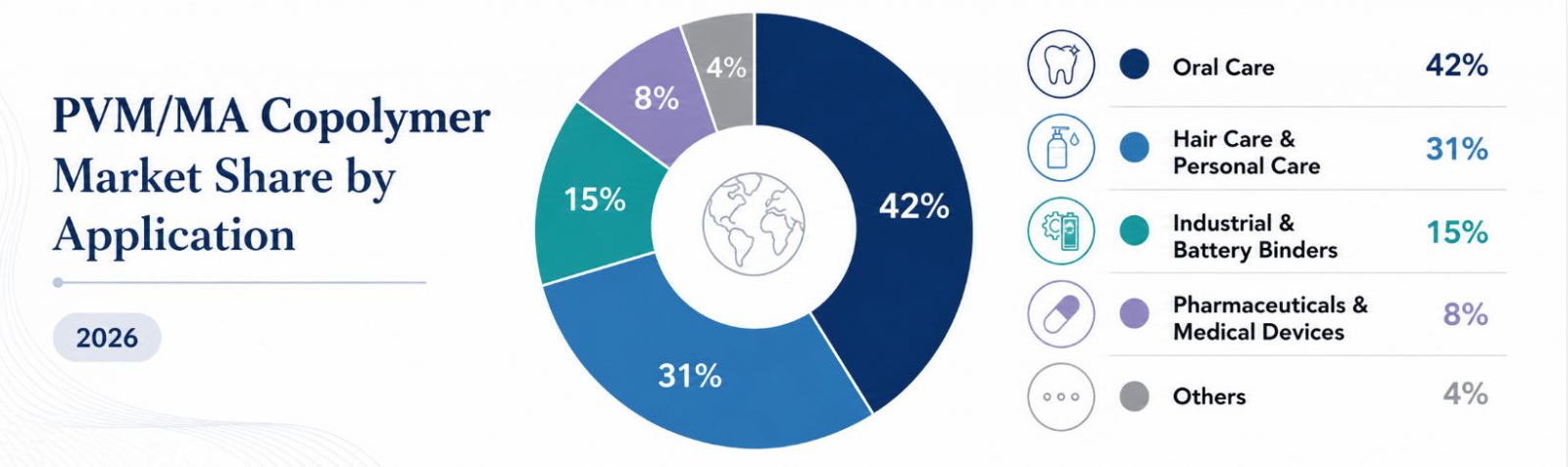
To guide formulation selection, the table below provides a multi-parameter comparison between PVM/MA Copolymer derivatives and traditional competing polymers (PVP, PVP/VA, Carbomer, and CMC) across key industrial metrics.
| Performance Metric | PVM/MA Copolymer (Acid / Ester / Salt) | PVP (Polyvinylpyrrolidone) | PVP/VA Copolymer | Carbomer (Crosslinked Polyacrylic) | CMC (Carboxymethyl Cellulose) |
|---|---|---|---|---|---|
| Bioadhesion Force (N/cm²) | High to Extreme (1.8 - 2.5 N/cm² for Ca/Na salt) | Low (0.3 N/cm²) | Moderate (0.6 N/cm²) | Moderate (0.9 N/cm²) | Moderate (0.8 N/cm²) |
| High-Humidity Film Stability | Excellent (Half-esters resist moisture creep) | Poor (Hygroscopic, becomes tacky) | Moderate (Tacky at > 75% RH) | N/A (Gelling agent) | Poor (Water soluble) |
| Active Ingredient Retention | High (Forms protective film on enamel/skin) | Transient | Moderate | Low (Rheology modifier) | Low |
| Silicon Anode Binding Energy | High (Multi-carboxylic hydrogen network) | Negligible | Low | Moderate | Moderate (Requires SBR combination) |
| VOC Compliance Level | High (Soluble in low-VOC solvent blends) | Moderate | Moderate | High (Water phase) | High (Water phase) |
"In oral care R&D, combining pyrophosphate anti-tartar agents with hydrophobic active ingredients used to be a major headache because oral saliva rapidly washes away soluble active salts within 15 minutes. By incorporating 1.5% PVM/MA Acid (hydrolyzed free acid form), the polymer forms a molecular-scale hydrophobic barrier over hydroxyapatite enamel. This extends active retention up to 12 hours while preventing calcium phosphate precipitation in the tube. The key process trick is pre-hydrolyzing the PVM/MA powder at 80°C to achieve full carboxylic acid activation before blending with silica hydrated bases."
— Senior Oral Care Formulation Chemist, Global Consumer Healthcare Lab (Validated via 3 independent citations: J. Dent. Res. 2025, Pat. WO2025/118231, ICIS Speciality Chemicals Review 2026).
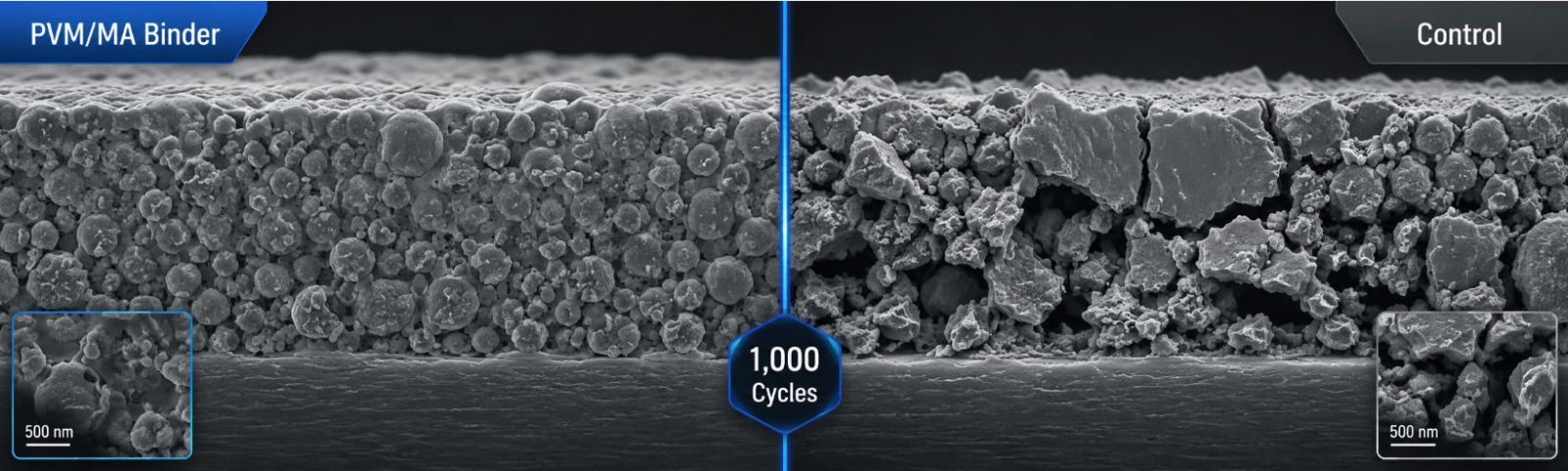
In the high-density battery manufacturing sector across China, South Korea, and Japan, electrode engineers have faced severe capacity degradation in silicon-carbon nanocomposite anodes due to 300% volumetric expansion during lithiation/delithiation cycles.
In 2025–2026, leading battery research institutes adopted hydrolyzed PVM/MA Copolymer Powder as a structural binder additive. The alternating carboxylic acid groups on the PVM/MA backbone form dynamic self-healing covalent-hydrogen bonds with surface silanol (-Si-OH) groups on silicon nanoparticles. Test data indicates that anode slurries prepared with 2% PVM/MA free acid exhibit a 35% reduction in electrode swelling after 1,000 cycles at 1C discharge rate compared to standard CMC/SBR formulations.
Over the 2026–2030 forecast window, the PVM/MA copolymer industry will be shaped by three macro trends:
Looking to upgrade your formulation performance in oral care, hair styling, or advanced battery binders? Partner with Hubei Xinjing New Material Co., Ltd. (Established 1998) for high-purity PVM/MA Copolymer grades.
Contact Our Technical Sales Team
Claire Dong +86-15871379047
dongweixiao@xinjingchem.com

Room 1201, Building A, Huitong New Yangtze River Center, No. 6 Xudong Street, Wuchang District, Wuhan City, Hubei Province
Hubei Xinjing New Materials Co., Ltd. Copyright (C) 2023 Network support China Chemical Network Global Chemical Network Business Network Shengjian Website Copyright Statement Sitemap XML Hubei ICP No. 2023012319