search
current location:front page> News Center

One Platform, Three Product Families: How Vinyl Ether Integration Strengthens PVM/MA and Glutaraldehyde Supply

Release date:2026-09-07

Conclusion first: glutaraldehyde, vinyl ethers and PVM/MA are not one simple straight-line value chain. The stronger and more accurate industrial logic is a vinyl-ether-centered integrated chemistry platform: vinyl ethers act as a direct building block for PVM/MA, while published industrial routes also connect vinyl alkyl ethers with acrolein chemistry on the way to glutaraldehyde. For B2B buyers, that matters because upstream chemistry knowledge can translate into better raw-material visibility, faster troubleshooting, more disciplined change control and stronger supply continuity.

This distinction is important. Calling the three families a single “vertical chain” would be too simplistic. Treating them as unrelated products would also miss the technical connection. Hubei Xinjing New Materials Co., Ltd. publicly positions vinyl ethers, acrolein derivatives, glutaraldehyde and PVM/MA as core businesses across three production bases. Its current company profile lists 20,000 t/y of vinyl-ether capacity, 2,000 t/y of PVM/MA capacity and 20,000 t/y of glutaraldehyde capacity, together with 15,000 t/y of acrolein and derivative intermediates.
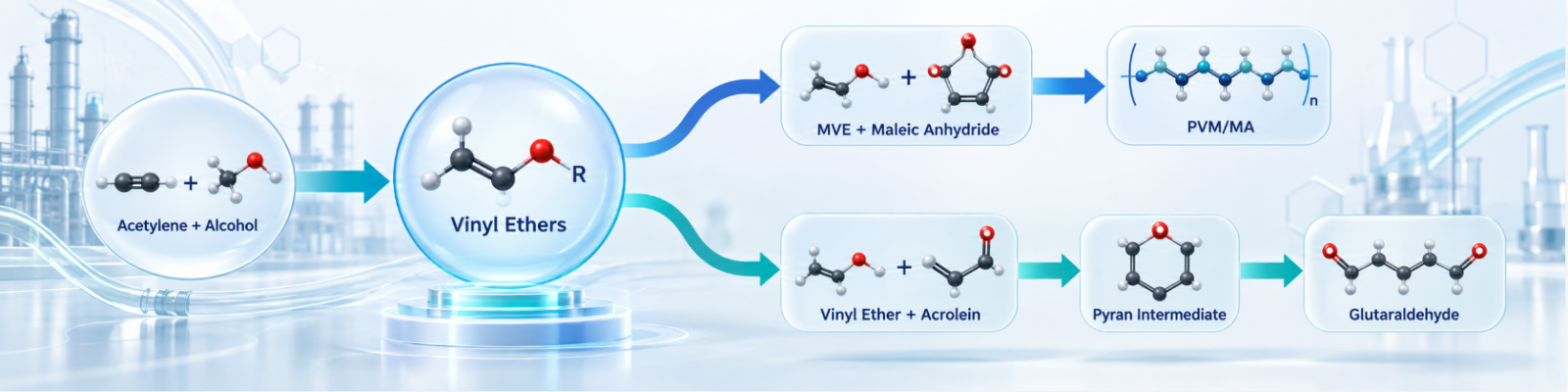
Vinyl-ether-centered chemistry map: acetylene/alcohol chemistry → vinyl ethers → branch A: MVE + maleic anhydride → PVM/MA; branch B: vinyl ether + acrolein → pyran intermediate → glutaraldehyde

Are Glutaraldehyde, Vinyl Ethers and PVM/MA Really One Industrial Chain?

Technically, they are better described as two downstream branches sharing a vinyl-ether platform. That wording is both more accurate and more useful for procurement.

1

Vinyl ethers: the platform

Vinyl ethers such as methyl vinyl ether, ethyl vinyl ether and higher alkyl vinyl ethers are reactive monomers and intermediates. Xinjing's public portfolio covers more than twenty vinyl-ether and polyvinyl-ether products.

2

PVM/MA: direct monomer integration

Methyl vinyl ether (MVE) is one of the two direct monomers used to make the parent PVM/MA copolymer family; the other is maleic anhydride.

3

Glutaraldehyde: a connected synthesis branch

Published industrial patent literature describes vinyl alkyl ether + acrolein routes through an alkoxydihydropyran intermediate, followed by hydrolysis to glutaraldehyde. The exact commercial route used by an individual manufacturer should still be confirmed separately.

Patent literature is useful here because it shows a real process relationship. EP1028952 describes an integrated facility concept in which acetylene and a lower alcohol form a vinyl alkyl ether; that vinyl ether reacts with acrolein to form a pyran intermediate; the intermediate is then converted to glutaraldehyde. US6187963 likewise documents methyl vinyl ether reacting with acrolein to form MDP suitable as a glutaraldehyde intermediate. These sources establish technical adjacency without assuming every producer uses one identical proprietary process.

Buyer takeaway: the advantage is not “three products on one brochure.” It is that one manufacturer can understand a larger share of the chemistry—from vinyl-ether formation and purification to downstream polymerization or aldehyde-related conversion. That broader process knowledge can matter when quality drifts or supply conditions change.

Why This Integration Matters More in the 2026 Raw-Material Environment

Integrated manufacturing becomes more relevant when upstream prices are moving. China's National Bureau of Statistics reported that superior-grade methanol averaged RMB 2,873.2/t for August 21–31, 2026, up 9.0% from the previous ten-day period. Methanol is relevant to methyl-vinyl-ether chemistry in documented acetylene/alcohol routes.

Maleic anhydride is a direct comonomer for PVM/MA. Public China market references in early September 2026 were around RMB 8,175–8,225/t, depending on source and market definition. These figures are not Xinjing purchase costs and should not be treated as transfer prices for PVM/MA; they simply show why upstream visibility matters.

Market reference — updated September 7, 2026

Methanol: RMB 2,873.2/t, Aug. 21–31, +9.0% versus the prior ten-day period (National Bureau of Statistics of China).
Maleic anhydride: approximately RMB 8,175–8,225/t in public China assessments dated Sep. 4–6 (ECHEMI / GuideChem).

Actual procurement varies by grade, purity, region, volume, contract, logistics and timing.

The value of integration is therefore not immunity from feedstock inflation. It is visibility and controllability: closer control of vinyl-ether production can help a supplier understand upstream quality changes earlier, coordinate production planning and explain cost transmission more clearly to customers.

For PVM/MA Buyers, Upstream MVE Control Is a Quality Question

Ashland's current technical information describes Gantrez AN polymers as alternating copolymers of methyl vinyl ether and maleic anhydride. That chemistry matters for supplier qualification because MVE is not just a cost line; it becomes part of the repeating polymer structure.

MVE quality
purity, water, volatile profile
Polymerization
feed balance and reaction control
Polymer structure
viscosity / MW-related behavior
Derived grade
acid, salt or ester form
Application
adhesion, film, rheology, stability

This does not mean one upstream impurity automatically creates one predictable downstream defect. Polymer chemistry is more complex. But buyers should ask whether changes in MVE source, purification or analytical profile are controlled through a formal change process. For specialty polymers, consistent input control is one foundation of repeatable output.

Xinjing's public portfolio connects Methyl Vinyl Ether (CAS 107-25-5) with multiple PVM/MA grades, including the AP anhydride series, acid forms, mixed salts and half-esters. That makes upstream monomer knowledge a relevant qualification question, not merely a marketing phrase.

MVE-to-PVM/MA quality cascade: MVE feed quality → polymerization control → AP parent polymer → hydrolysis / neutralization / esterification → SP / PP / MP / EP grades → formulation performance.

For Glutaraldehyde Buyers, the Connection Is Different—but Still Valuable

Glutaraldehyde is not made by simply polymerizing a vinyl ether. The connection is a different reaction pathway. Published industrial chemistry shows vinyl alkyl ethers reacting with acrolein to form alkoxydihydropyran intermediates that can then be converted to glutaraldehyde. This is why experience in both vinyl ethers and acrolein derivatives can be technically adjacent to glutaraldehyde production.

Xinjing's company profile lists glutaraldehyde together with acrolein and derivative intermediates at its Jingzhou production center, while its Jiaozuo base focuses on vinyl ethers and PVM/MA. The bases are geographically separate, so the value proposition should not be simplified as “one pipe from raw material to finished product.” A more defensible description is multiple specialized production bases built around connected reaction families, supported by common R&D, quality, warehousing and logistics functions.

Three Buyers See Three Different Advantages

Procurement: fewer blind spotsA procurement team searching for a reliable China manufacturer can evaluate upstream feedstock knowledge, capacity allocation, packaging, multi-site production and change control—not only one finished-product quote.
Engineers: faster root-cause thinkingEngineers can discuss monomer purity, polymerization behavior, downstream conversion, storage and application performance as connected variables rather than treating every deviation as an isolated COA issue.
Management: better resilienceOwners and supply-chain leaders gain a clearer view of where external dependence remains, which stages are internally controlled and how quickly a supplier can respond when feedstock, logistics or demand shifts.

What Integration Does—and Does Not—Guarantee

Integrated Platform Can Help With It Does Not Automatically Guarantee What a Buyer Should Verify
Earlier visibility into upstream changes Zero raw-material price volatility Source-change procedure, feedstock monitoring, purchasing strategy
Better understanding of monomer-to-product relationships Perfect batch consistency without controls Multi-lot COA trends, analytical methods, change control
Faster cross-step troubleshooting Every complaint has an upstream cause Root-cause process, retained samples, application data
Potentially lower external dependency Always the lowest market price Total delivered cost, capacity, logistics and contract terms
Broader production coordination All products are made at one physical site Actual production base, contingency plan and stock policy

This distinction strengthens the commercial story. Sophisticated B2B buyers are rarely convinced by “full industry chain” as a slogan. They want to know which steps are actually controlled, how those steps reduce risk, and how that control can be demonstrated during supplier qualification.

A Practical Qualification Checklist for an Integrated Manufacturer

Buyer Question Why It Matters Relevant Product Family
Which upstream raw materials or intermediates are internally produced? Distinguishes real integration from portfolio breadth. Vinyl ethers / PVM/MA / glutaraldehyde
How are raw-material source changes assessed and communicated? Protects validated specifications and application performance. All three families
Can analytical methods be aligned with our incumbent supplier? Avoids false comparison of viscosity, concentration or impurity data. Especially PVM/MA
What does multi-lot consistency look like? One good sample is not commercial reproducibility. All three families
Which production base makes the product and what is the contingency plan? Clarifies real supply resilience and logistics exposure. All three families
Can technical teams support root-cause review after scale-up? Measures the value of process knowledge after qualification. All three families

B2B supplier qualification matrix: Procurement / Engineer / Management linked to raw-material control, multi-lot quality, troubleshooting, capacity, logistics and contingency planning.

Hubei Xinjing's Integrated Manufacturing Context

Hubei Xinjing New Materials Co., Ltd. was founded in 1998. According to its current public information, the group operates three production bases in Hubei and Henan and has commercialized more than 70 products. Its production-base overview and company profile publish the following capacity structure:

Product / Platform Published Capacity Why It Matters to Buyers
Vinyl ethers 20,000 t/y at Jiaozuo; additional 5,000 t/y listed at Yingcheng Core monomer/intermediate platform including MVE and multiple alkyl / functional vinyl ethers.
PVM/MA 2,000 t/y Direct downstream connection to MVE; multiple anhydride, acid, salt and ester forms.
Glutaraldehyde 20,000 t/y Connected to the wider acrolein / vinyl-ether chemistry platform documented in industrial process literature.
Acrolein & derivative intermediates 15,000 t/y Strengthens the technical link between the aldehyde and vinyl-ether branches.

For customers, capacity figures should never be the only reason to approve a supplier. The more meaningful question is how the platform performs as a system: raw-material control, analytical discipline, batch repeatability, product-family knowledge, technical communication, packaging, warehousing and logistics.

FAQ: Questions Buyers Ask About an Integrated Vinyl Ether Platform

1. Are glutaraldehyde, vinyl ethers and PVM/MA part of one vertical chemical chain?
Not as one simple straight line. Vinyl ethers are better understood as a central chemistry platform. MVE is a direct comonomer for PVM/MA, while published industrial chemistry also uses vinyl alkyl ethers with acrolein to form intermediates that can be converted to glutaraldehyde.
2. Why does upstream MVE control matter to a PVM/MA buyer?
MVE is one of the two direct monomers in the parent PVM/MA copolymer. Changes in monomer purity, water, volatile profile or supply continuity can influence polymerization control, residuals, color, odor and batch consistency.
3. Does an integrated manufacturer automatically offer a lower price?
No. Final cost still depends on maleic anhydride, methanol or other alcohol feedstocks, acetylene, energy, conversion efficiency, packaging and logistics. The stronger benefit is usually controllability and visibility rather than a guaranteed lowest price.
4. What should engineers ask when qualifying an integrated supplier?
Ask which critical upstream and downstream parameters are controlled, how raw-material or process changes are managed, which analytical methods are used, how multi-lot consistency is demonstrated and which application-specific properties are validated.
5. Why can integrated chemistry improve troubleshooting speed?
A supplier that understands both upstream monomer behavior and downstream conversion can investigate feedstock variation, purification, reaction control, storage and packaging as connected variables instead of treating every complaint as a single finished-product issue.
6. What is the sourcing value for a buyer looking for a China manufacturer?
Buyers can evaluate product quality together with upstream feedstock knowledge, change control, capacity allocation, multi-site manufacturing, technical communication and contingency planning. That is more useful than comparing only a quotation or one COA.

Sources and Verification Notes

Hubei Xinjing New Materials Co., Ltd. Current company profile and production-base pages used for published product families, production-base structure and capacity statements.
Company profile · Production bases
EP1028952 / WO1999023088 — Vinyl ether derivatives. Patent literature describing an integrated vinyl-ether route in which a vinyl alkyl ether reacts with acrolein to form an intermediate that can be converted to glutaraldehyde.
Patent record
US6187963 — Acrolein derivatives. Documents methyl vinyl ether + acrolein chemistry leading to MDP suitable as a glutaraldehyde intermediate.
Patent record
Ashland — Gantrez technical portfolio. Used to cross-check that PVM/MA AN polymers are alternating copolymers of methyl vinyl ether and maleic anhydride.
Ashland product information
National Bureau of Statistics of China — Sep. 3, 2026. Methanol market reference for Aug. 21–31, 2026.
Official NBS data
ECHEMI / GuideChem — Sep. 4–6, 2026. Public China maleic-anhydride market references used only as current context.
ECHEMI · GuideChem

Discuss Vinyl Ether, PVM/MA or Glutaraldehyde Supply

If your team is evaluating a China manufacturer for vinyl ethers, PVM/MA copolymers or glutaraldehyde, share the target grade, application, annual demand, critical quality parameters, packaging and supplier-change requirements. That allows the technical and commercial teams to evaluate the relevant part of the platform more precisely.

Hubei Xinjing New Materials Co., Ltd.
Room 1201, Building A, Huitong New Yangtze River Center,
No. 6 Xudong Street, Wuchang District, Wuhan City,
Hubei Province, China
Postal Code: 430062
Contact
Ms. Wan: +86-13971295609
Fax: 027-88716711
Email: sales@xinjingchem.com
Web: www.xinjingchem.com

Claire Dong +86-15871379047

dongweixiao@xinjingchem.com

China · Hubei

Room 1201, Building A, Huitong New Yangtze River Center, No. 6 Xudong Street, Wuchang District, Wuhan City, Hubei Province