

in 2026, qualifying a second source for PVM/MA is becoming less about finding a cheaper “Gantrez replacement” and more about proving that a new supplier can reproduce the chemical form, analytical window, formulation behavior, documentation quality and supply continuity required by the incumbent process. The commercial opportunity is real, but the technical bar is much higher than a CAS-number match.
Ashland announced in March 2026 that IMCD would become its exclusive U.S. distributor for personal care and home care ingredients, including oral care, effective April 1. At the same time, Ashland's fiscal 2026 Q2 and Q3 disclosures showed continued low-single-digit growth in oral and home care. These are not PVM/MA sales figures, but together they create a useful sourcing signal: end-use demand remains active while channel structure is more concentrated. For procurement teams, that makes supply redundancy worth re-examining.
For U.S. buyers in particular, this distinction matters because a second-source project is rarely triggered by one dramatic event. More often it is driven by accumulated operating concerns: longer replenishment cycles, internal dual-sourcing policy, customer requests for contingency planning, regional inventory requirements, or a desire to reduce dependence on one branded channel. None of these automatically justify switching suppliers, but together they make qualification work strategically useful.
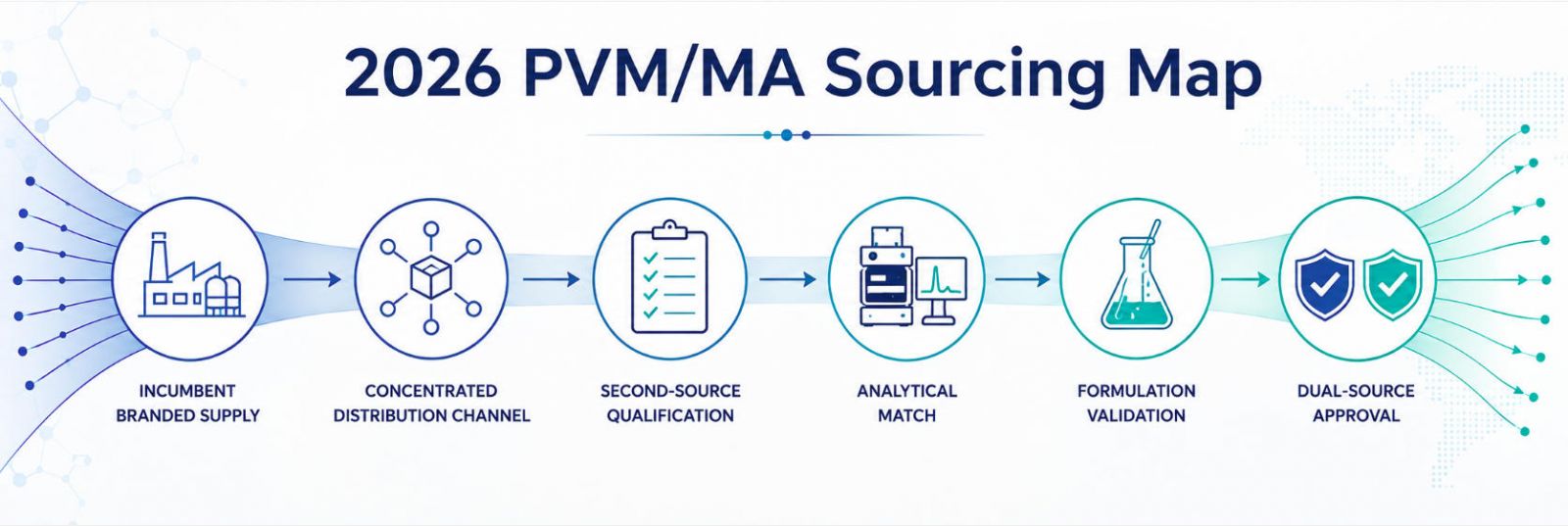
Why “Same CAS” Is Not the Same as “Same Grade”
PVM/MA is not one interchangeable powder. Hubei Xinjing's PVM/MA portfolio separates the platform into AP anhydride, SP and PP acid forms, MP mixed salts, and EP half-esters. Each form changes what buyers need to validate.
| Series | Published Identity | Delivery Form | Qualification Focus | Internal Link |
|---|---|---|---|---|
| AP | PVM/MA anhydride CAS 9011-16-9 |
Powder | Active content, loss on drying, specific viscosity, anhydride functionality, dissolution behavior | AP Series |
| SP | PVM/MA acid CAS 25153-40-6 |
Viscous liquid | Dry content, pH, aqueous viscosity, delivered active polymer | SP Series |
| PP | PVM/MA acid CAS 25153-40-6 |
Powder | Loss on drying, dissolution, pH and viscosity method | PP Series |
| MP | PVM/MA mixed salts CAS 62386-95-2 |
Powder | Ionic composition, calcium level, pH, water content and adhesion performance | MP Series |
| EP225 | PVM/MA half ester CAS 25087-06-3 |
Viscous liquid | Dry content, acid number, exact ester chemistry, odor/color, film behavior | EP225 |
| EP425 / EP435 | PVM/MA half ester CAS 25119-68-0 |
Viscous liquid | Exact grade identity, dry content, acid number and application compatibility | EP425 / EP435 |
The practical rule is straightforward: qualify the form actually used in the formulation, not the polymer family in the abstract. A mixed salt used in denture adhesive is not directly interchangeable with an anhydride powder merely because both belong to PVM/MA chemistry. Even SP and PP share the same published CAS, yet delivery form and processing behavior differ.
The same logic applies to downstream applications. In oral care and denture adhesives, the polymer may contribute adhesion, retention, film behavior or interaction with salts and other formulation components. In personal care and home care, the key performance variable may instead be film formation, deposition, rheology or compatibility. A grade that is analytically close but functionally weak in the intended formulation is not a qualified second source.
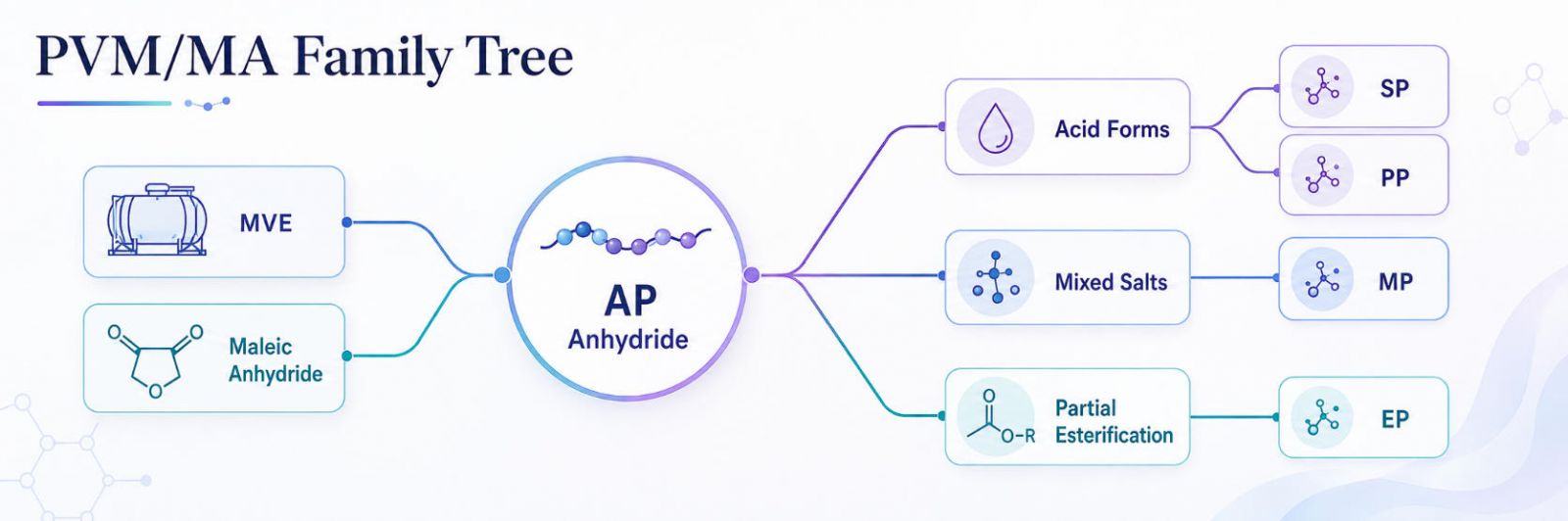
Five Layers of Equivalence Buyers Should Check
This sequence prevents a common error: moving directly from “same name” to “same price.” In specialty polymers, the costly part of a failed switch is usually not the sample. It is repeated formulation work, additional stability testing, rejected batches, emergency inventory or process disruption.
Four Technical Checks That Matter More Than the Product Name
1. Compare viscosity only when the method is comparable
Viscosity is method-dependent. Hubei Xinjing's published AP and PP specifications refer to specific viscosity in a 1% butanone solution, while the SP series uses a 1% aqueous solution. Those values should not be compared directly. Buyers need the solvent, polymer concentration, temperature, instrument and method—not only the number.
Method alignment is especially important when a buyer is comparing an incumbent branded specification with a Chinese supplier's published TDS. Polymer data often look deceptively simple because both documents may use the word “viscosity,” yet one may report specific viscosity, another Brookfield viscosity, and a third a value measured at a different concentration. The correct response is not to force the numbers into a direct comparison, but to establish a common analytical basis or rely on application-side equivalence testing.
2. Compare active polymer, not only delivered mass
For solution grades, the quoted mass includes water or solvent. A simple active-basis calculation makes comparisons more meaningful:
This does not replace a full cost model, because freight, dilution or dissolution labor, tankage and validation can still change the commercial result.
3. Treat pH, acid number and ionic composition as formulation variables
For acid, mixed-salt and half-ester grades, these parameters reflect chemical form and can influence neutralization demand, solubility, film behavior and interactions with other formulation components. In mixed salts, ionic composition can also be linked to adhesive performance.
4. Validate multiple lots, not one perfect sample
A single sample cannot prove commercial repeatability. A stronger program compares multiple lots and reviews how the supplier manages change control. For polymers, lot-to-lot consistency matters because molecular-weight distribution and processing history may influence end-use behavior even when headline COA values are within limits.
Raw-Material Risk: MVE and Maleic Anhydride Need Separate Tracking
PVM/MA cost and supply risk cannot be understood by watching one upstream price. The parent copolymer is based on methyl vinyl ether (MVE) and maleic anhydride (MA), and the two inputs have different supply-chain logic. MVE brings vinyl-ether manufacturing, purification and pressure-handling considerations; MA is more closely linked to large oxidation units, operating rates, regional logistics and feedstock economics.
China's National Bureau of Statistics reported on August 9, 2026 that July purchase prices for chemical raw materials were 9.3% higher year on year but 2.6% lower month on month. This is useful only as a macro direction signal—it is not an MVE or MA spot price. A defensible PVM/MA cost model should separately consider MVE, MA, polymerization control, hydrolysis/neutralization or esterification, drying or solution preparation, packaging and logistics.
Raw-material resilience also has a quality dimension. A sudden change in monomer source, impurity profile or purification load may not immediately create an out-of-specification result, yet it can increase variability in color, odor, residual monomer or polymerization behavior. For qualification teams, the useful supplier question is therefore not simply “Do you have enough capacity?” but “How are upstream changes detected, evaluated and communicated before they affect the approved grade?”
| Cost / Risk Block | Why It Matters | What Buyers Can Ask |
|---|---|---|
| MVE | Core vinyl-ether monomer; purity, handling and availability affect consistency and cost. | How is MVE sourced and what happens if the source changes? |
| Maleic Anhydride | Core comonomer; operating rates, purity and logistics can transmit into polymer economics. | Is there dual-source capability and how are supplier changes qualified? |
| Polymerization / MW control | Influences viscosity and application behavior. | Which in-process controls protect batch consistency? |
| Downstream conversion | Hydrolysis, neutralization or esterification creates SP/PP, MP and EP behavior. | Which parameters are locked for the exact grade? |
For buyers evaluating methyl vinyl ether and downstream PVM/MA from the same industrial group, the useful question is not simply whether the supplier is vertically integrated. The more important question is whether upstream knowledge improves raw-material traceability, change control and communication when supply conditions move.
Why Broad Trade Data Can Mislead PVM/MA Market Decisions
Hubei Xinjing's published PVM/MA grades list HS code 3907209090, but that code is not unique to PVM/MA. It covers a broader polyether-type category. Therefore aggregate customs tonnage or unit value should not be presented as precise PVM/MA demand, market price or supplier share without shipment-level product identification.
A More Useful Buyer Scorecard
| Dimension | Weak Comparison | Better Comparison |
|---|---|---|
| Price | US$/kg delivered | Active-polymer cost + freight + handling + processing |
| Quality | “Same CAS” | Exact form + grade + method + multi-lot window |
| Performance | Brochure claims | Customer-side formulation and stability data |
| Supply | Lead time today | Normal lead time + packaging + change control + contingency capability |
| Documentation | COA available | Method alignment + SDS/TDS + traceability + change notification |
This is why “replacement” is often the wrong commercial word. A procurement team is not replacing a trademark; it is qualifying an alternate material against a defined formulation and quality system.
For strategic materials, a buyer may also score the alternative source against three scenarios: normal operation, seasonal demand growth and disruption. A supplier that performs well only under normal conditions may still leave the buyer exposed when packaging, port congestion or upstream shortages appear. This is why supplier qualification should include realistic lead-time ranges and contingency communication, not only a standard quotation.
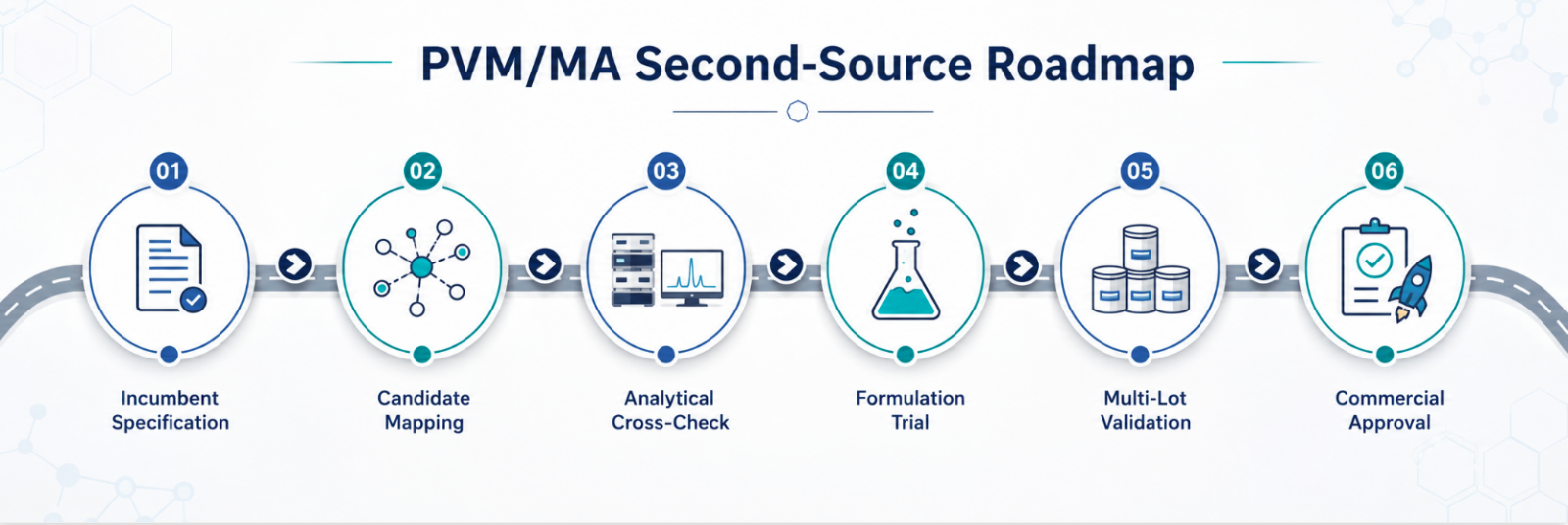
A Practical Second-Source Qualification Sequence
The workflow does not need to be bureaucratic. For a straightforward industrial application, several steps can run in parallel. For oral-care or other tightly controlled formulations, buyers may need additional toxicological, microbiological, regulatory or customer-approval review. The important point is that the qualification plan is defined before the commercial decision, so technical failure is discovered at laboratory scale rather than after supply has been committed.
Where Hubei Xinjing Fits Into a Second-Source Strategy
Hubei Xinjing New Materials Co., Ltd. was founded in 1998 and publicly describes three production bases across Hubei and Henan. Its company profile states that the Jiaozuo base has vinyl-ether capacity of 20,000 t/y and PVM/MA capacity of 2,000 t/y. For a buyer, the practical relevance is the ability to discuss the upstream vinyl-ether side and the downstream polymer family within one supply context.
The company's PVM/MA product family includes AP, SP, PP, MP, EP225 and EP425/EP435. A serious inquiry should therefore begin with the incumbent grade or target chemistry, application, delivery form, test method, active/solids target, pH or acid-number window, packaging and required documentation—not with a request for the cheapest sample.
FAQ: What Technical Buyers Should Ask
Sources and Verification Notes
Official release
Q2 · Q3
Official NBS release
Discuss a PVM/MA Second-Source Qualification
If you are evaluating an alternative PVM/MA source for oral care, denture adhesive, personal care, home care, coatings, inks or another specialty formulation, provide the incumbent grade or target chemistry together with the critical specification window. Hubei Xinjing can then discuss a more relevant AP, SP, PP, MP or EP candidate before sample validation.
Room 1201, Building A, Huitong New Yangtze River Center,
No. 6 Xudong Street, Wuchang District, Wuhan City,
Hubei Province, China

