

“Glutaraldehyde, CAS 111-30-8, ten tonnes” looks like a complete request for quotation. It is not. The same chemical identifier appears on four different product listings on Hubei Xinjing New Materials' website. Before comparing price and lead time, a buyer needs to identify the intended commercial form, target concentration, application and documents. A manufacturer can then answer the question that actually matters: which available product matches this particular process?
The Xinjing glutaraldehyde catalogue lists Glutaraldehyde, Glutaraldehyde technical, Glutaraldehyde sterilizing agent and Modified glutaraldehyde. Each entry carries CAS 111-30-8. The CAS number identifies the principal chemical named on the pages; it does not establish that the four commercial products have identical formulations, assays, permitted uses or qualification packages.
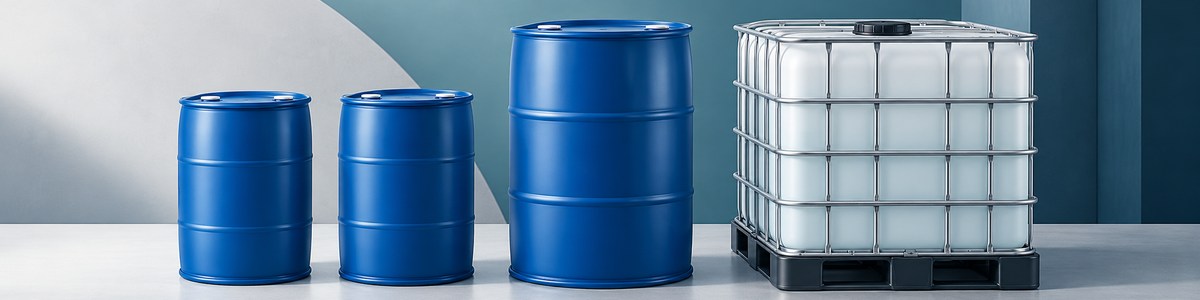
The public product pages show 25 kg and 220 kg plastic drums and a 1,100 kg IBC option. They do not provide a single concentration and impurity specification that can be applied to every entry. Treat those figures as published catalogue information and confirm the current offer and batch documentation directly with the supplier.
| Xinjing listing | First question for the buyer | What to obtain before approval |
|---|---|---|
| Glutaraldehyde | What is the intended use and target active content? | Current product specification, COA format and sample availability. |
| Glutaraldehyde technical | Which industrial process and acceptance limits apply? | Assay method, relevant impurities, appearance and batch tolerance. |
| Glutaraldehyde sterilizing agent | Is the request for a formulated product in a particular market? | Exact formulation and destination-market registration or efficacy evidence where required; the catalogue name alone is not an approval. |
| Modified glutaraldehyde | Which modification and performance target are required? | A grade-specific technical description and compatibility data for the customer's use. |
According to its company profile, Hubei Xinjing New Materials traces its establishment to 1998 and describes three production bases. Its website lists annual glutaraldehyde capacity of 20,000 tonnes. These are useful starting points for a supplier assessment, but published capacity is not the same as available inventory, a fixed lead time or a guarantee for every listed grade.
The practical advantage of talking to the manufacturer is direct discussion of grade, test method, batch documents, packaging and a planned delivery schedule. For a new qualification, ask which legal entity and production site will appear on the offer, COA and shipping documents. Resolve any differences before a trial batch becomes a recurring purchase.
Four separate glutaraldehyde catalogue entries allow the RFQ to name a specific product page.
Request the current specification, a representative COA, SDS and package details for the proposed grade.
Separate stated annual capacity from confirmed production slot, stock and shipment timing.
A useful glutaraldehyde RFQ states the destination market and end use first. Follow with the required active content or assay basis, acceptable pH and impurity limits if relevant, sample size, annual forecast, lot size and packaging. Ask how the supplier reports analytical results and whether the same limits are maintained across the planned purchasing period.
Where a product is described as a sterilizing agent, the buyer must separately verify the formulation and applicable market requirements. A product name or CAS number is not proof of registration, clinical suitability or sterilization performance. Industrial uses also require the customer's own application and safety assessment.

Xinjing's glutaraldehyde pages list 25 kg and 220 kg plastic drums and 1,100 kg IBC packaging. Confirm which of these are available for the chosen grade and shipment, as well as the actual fill, container compatibility, shelf-life basis, label language and transport documents. A small sample and an IBC shipment may require different handling arrangements.
Compare quotations on a like-for-like basis: the same proposed grade, concentration, net quantity, Incoterm, document set and delivery window. Otherwise a lower unit price can conceal a different product or a costly requalification.
The official contact page lists Christi Duan, +86-13667170329, and hbxj9@xinjingchem.com. Send the technical RFQ above so the sales and quality teams can answer against a defined grade rather than a CAS number alone.
No. Hubei Xinjing lists four glutaraldehyde entries under CAS 111-30-8, but their commercial specifications and intended uses must be confirmed separately. Approve the exact offered grade and batch documents for your process.
No single concentration is stated across the four public glutaraldehyde entries. Ask Hubei Xinjing to confirm the active content, assay method and tolerance of the product it is actually offering.
Hubei Xinjing's glutaraldehyde pages list 25 kg and 220 kg plastic drums and a 1,100 kg IBC. Confirm availability, fill, compatibility and shipping documents for the chosen grade and destination.
No. Hubei Xinjing's catalogue name does not by itself establish a specific glutaraldehyde formulation's registration, permitted claims or efficacy in a destination market. Request the relevant documents and assess local requirements before use.
No. The website states annual glutaraldehyde capacity of 20,000 tonnes; it does not establish current stock for a particular grade. Request a dated quotation, production schedule and confirmed lead time.
For glutaraldehyde, specify the intended use and country, exact catalogue entry, concentration or assay basis, quality limits, packaging, volume, documentation and delivery terms. Hubei Xinjing can then confirm the current grade-specific offer.
Editorial statement: This article was prepared for Hubei Xinjing New Materials Co., Ltd. from the company's public pages available on 26 October 2026. Catalogue listings and stated capacity are attributed to the website, not independently audited; concentrations, regulatory status, stock, lead times and final specifications require current written confirmation. Images are conceptual illustrations.
Topics: Glutaraldehyde, CAS 111-30-8, Chemical manufacturer, B2B sourcing, Grade selection, COA, Industrial chemicals, Xinjing New Materials

Mr.Wang +86-15926261626
hbxj5@xinjingchem.com

Room 1201, Building A, Huitong New Yangtze River Center, No. 6 Xudong Street, Wuchang District, Wuhan City, Hubei Province
Hubei Xinjing New Materials Co., Ltd. Copyright (C) 2023 Network support China Chemical Network Global Chemical Network Business Network Shengjian Website Copyright Statement Sitemap XML Hubei ICP No. 2023012319